
Himani Baxi, Welcomes YOU
Economics for people, not for profit

Latest

Publication date: 14 Nov 2025:
This article explores the fundamental theories behind Sustained Economic Growth (SEG), particularly in the context of technological progress and Nobel-recognized research. The piece highlights the crucial contributions of economists like Joel Mokyr, Peter Klenow, and Chad Jones, whose work emphasizes innovation and technical change as the primary engines of long-term economic development.
About Me

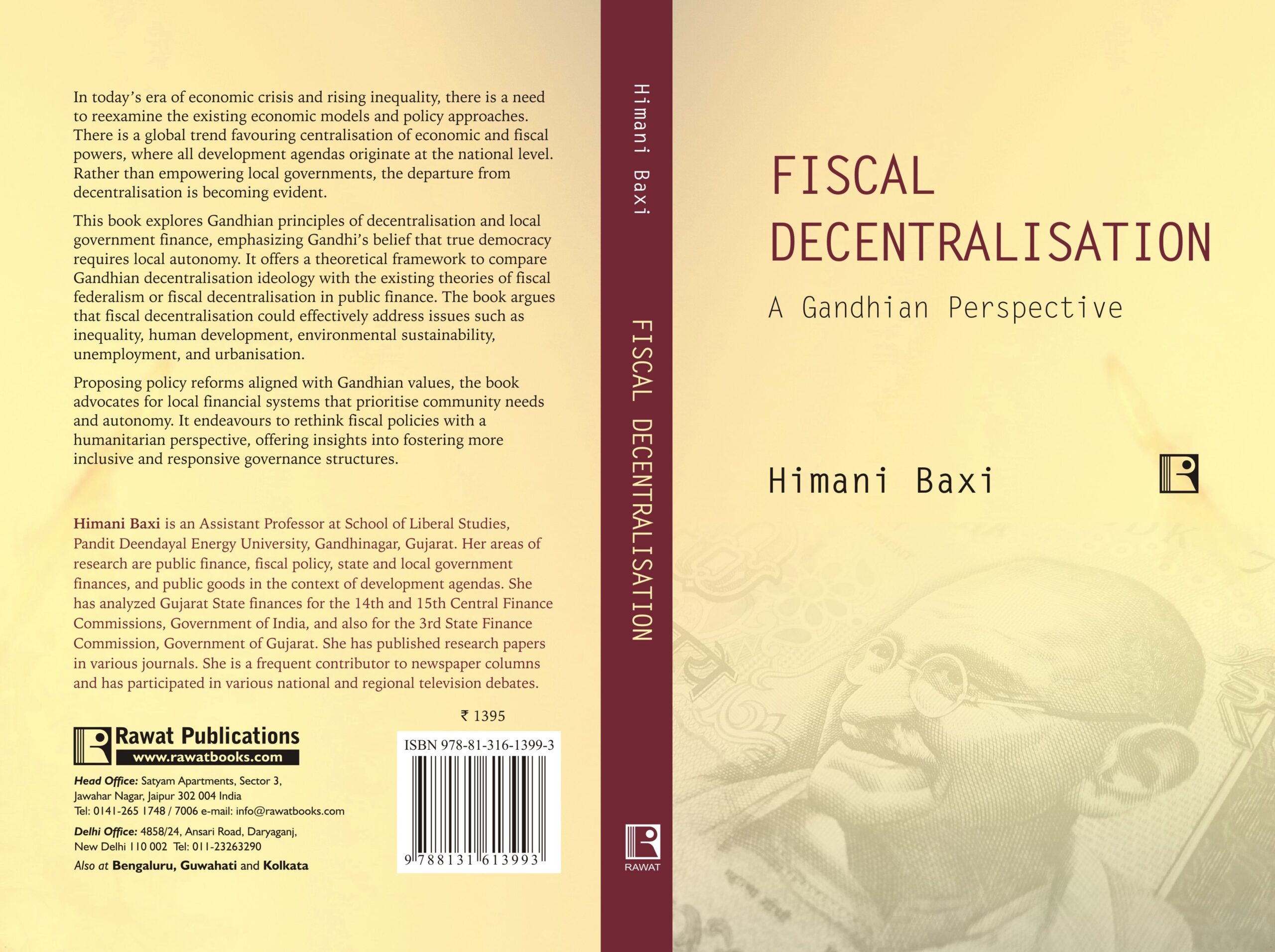
Fiscal Decentralisation – A Gandhian Perspective

What I Do
I am Dr. Himani Baxi, assistant professor at School of Liberal Studies, Pandit Deendayal Energy University (PDEU). I am a passionate teacher and avid researcher of economics. Born and brought up in Gujarat, I have completed my masters from M S University Baroda and PhD from Gujarat University. Since 2001, I am engaged in teaching and research. My areas of research are fiscal policy, state and local government finances, public goods in context of development agendas.
I am recently working on the project supported by UNICEF – Gujarat. Here I am preparing a Policy Advocacy for Child-Focused Devolution to local governments in Gujarat.
I have recently submitted a report to 16th Central Finance Commission on Gujarat fiscal performance analysis.
I have analysed Gujarat State finances for the 14th and 15th Central Finance Commission, Government of India and also for 3rd State Finance Commission, Government of Gujarat.
My teaching interest include macroeconomics, public finance and public goods, Indian economic policy, development studies, urban economics etc.
With the very purpose of bringing economics to the community and simplify it for the common man, I write a column “ARTHKARAN” in “Navgujarat Samay” a Gujrati daily newspaper. In this column I discuss various dimensions of the current economic issues from national and international perspective and bring new dimension which touches the life of common people.
Himani Baxi
Research Highlights
Pranay Purohit & Himani Chinmay Baxi, 2025. "Asymmetric Effects of Environmental Taxes, Regulatory Quality, and Fossil Fuel Use on Renewable Energy Consumption: A Quantile Analysis of G-20 Countries," Journal of Tax Reform, Graduate School of Economics and Management, Ural Federal University, vol. 11(3), pages 576-591.
The G-20 currently produces about three-quarters of global greenhouse gases while renewables meet only 14 % of its final-energy demand, raising doubts about whether conventional levers– carbon taxes, better governance and fossil-fuel phase-outs– work the same everywhere. Drawing on balanced annual data for 20 G-20 + EU economies from 2001 to 2020 (400 observations), this study deploys cross-sectionally augmented unit-root tests followed by Machado–Santos-Silva panel quantile regression to track how environmental-tax effort, World-Bank regulatory quality scores and the fossil share of electricity influence renewable-energy consumption across the entire distribution of adopters. The evidence is distinctly asymmetric. A one-percentage-point rise in green-tax revenue lifts the renewable share by only 2.1 percentage points at the 10th quantile but by 4.6 points at the 90th, revealing a fourfold gain for leaders. Fossil dependence exerts the opposite pull, its negative effect deepening from –0.08 to –0.36 points as countries climb the adoption ladder, signalling a robust lock-in constraint. Regulatory quality on its own shows diminishing returns, yet when interacted with taxation it turns significantly positive above the median, confirming that good institutions magnify, rather than replace, price signals. Model fit strengthens toward the upper tail (pseudo-R² rises from 0.18 to 0.41), underscoring the need for distribution-aware policy analysis. The findings imply that tiered or self-escalating carbon prices, coupled with transparent revenue recycling and targeted fossil-subsidy withdrawal, can accelerate renewable uptake far more effectively than flat rates or governance reforms alone, offering a nuanced roadmap for decarbonising the heterogeneous G-20 bloc.
Revenue Expenditure Nexus of Indian States: Panel ARDL Approach, International Journal of Social Economics, Vol. ahead-of-print No. ahead-of-print.
Impact of Demonetization in Rural Areas Through the Lens of Financial Inclusion, Journal of Rural Development 41 (1), 120-135, January – March 2022 DOI:
http://dx.doi.org/10.25175/jrd%2F2022%2Fv41%2Fi1%2F172466
The paper studies the impact of demonetisation that was announced in the year 2016 on the rural population of Kutch district of Gujarat state. Rural areas in India, with about 38 per cent of bank branches in August 2016 (RBI 2017) and 69 per cent of the population (Census 2011), it will be critical to experience demonetisation. In this context, the study examines the hypothesis that the segment of the population which could easily access banking facilities and shift to cashless transaction might have had to bear the lower cost of demonetisation than those who could not. Both supply and demand side of the status of financial inclusion is considered. Although the study did not find any significant difference in the cost of exchange or impact on consumption and income between the inclusive group and excluded group, it implicitly brings out the challenges of financial inclusion in the rural economy.
see research
Baxi H (2019), “Social Expenditure and Human Development in Gujarat", Economic Political Weekly, Vol 54, No14, pp 58-64
see research
A report submitted to 15th Finance Commission government of India
see research
Baxi H, “Role of State and Federal Finance for Economic Development of Gujarat”
see research

Economics Teaching
Want to get some interesting information on the courses? I teach Economics of Social Sector, Public Economics, Comparative Economics, Development Economics, Macroeconomics. One can easily fall in love with these subjects.
Experience the economic situations using simulation techniques and learn to take rational decisions as either firm, consumer or the government. These helps students enhance the understanding of core concepts of economics
Simulation helps to get feeling of economics , whiPower of experiments
Experience the economic situations using simulation techniques and learn to take rational decisions as either firm, consumer or the government. These helps students enhance the understanding of core concepts of economics
For courses like Public Economics, Development Economics, students learn to access original macroeconomic data sets and explore the trend of economic variables by themselves. There is nothing more exciting than to observe the economic trend by yourself.

Prominent Work
Writing a book on Decentralizing Finance: A Gandhian Perspective. In this book, I am trying to connect the fiscal federalism and fiscal decentralization theories with the Gandhian ideas of ‘Gram Swaraj’, ‘And Panchayati Raj’.
Working with Institute for Social Action and Research for the sponsored project of UNICEF Gujarat. The project focuses on Gender transformation and empowerment through life skill training of adolescent girls and boys of Rapar block of Kachchh district, Gujarat. I am primarily involved for the base line and endline survey and process document work
Working on Dried Fish Matter in Gujarat. Connected with the Social Sciences and Humanities Research Council of Canada funded project Dried Fish Matters: Mapping the Social Economy of Dried Fish in South and Southeast Asia for Enhanced Wellbeing and Nutrition. The project is conducting research on dried fish value chains in six countries in South and Southeast Asia, and four regions in India. Started in May 2018, will be completed by 2025.
Newspaper Articles


Indian Industries

Indian banking and monetary issues

Public Goods and development

Covid 19
Find My Research
You can get access to my research work through research gate or google scholar. Feel free to write me an email or message me in case you are unable to download the full paper.
Let’s get connected for Economics.
Email: joshi.himani@gmail.com
Call: +9198-7979-0045